
I work with high-net-worth individuals, family offices, and funds who already hold meaningful digital capital on major crypto exchanges (e.g., Binance) and want INSTITUTIONAL-GRADE EXECUTION — without giving up custody.Through Link.Investments, I run NON-CUSTODIAL, RULES-BASED TRADING MANDATES that operate inside your own exchange account (or sub-account), using trade-only API access and a pre-defined risk framework…more
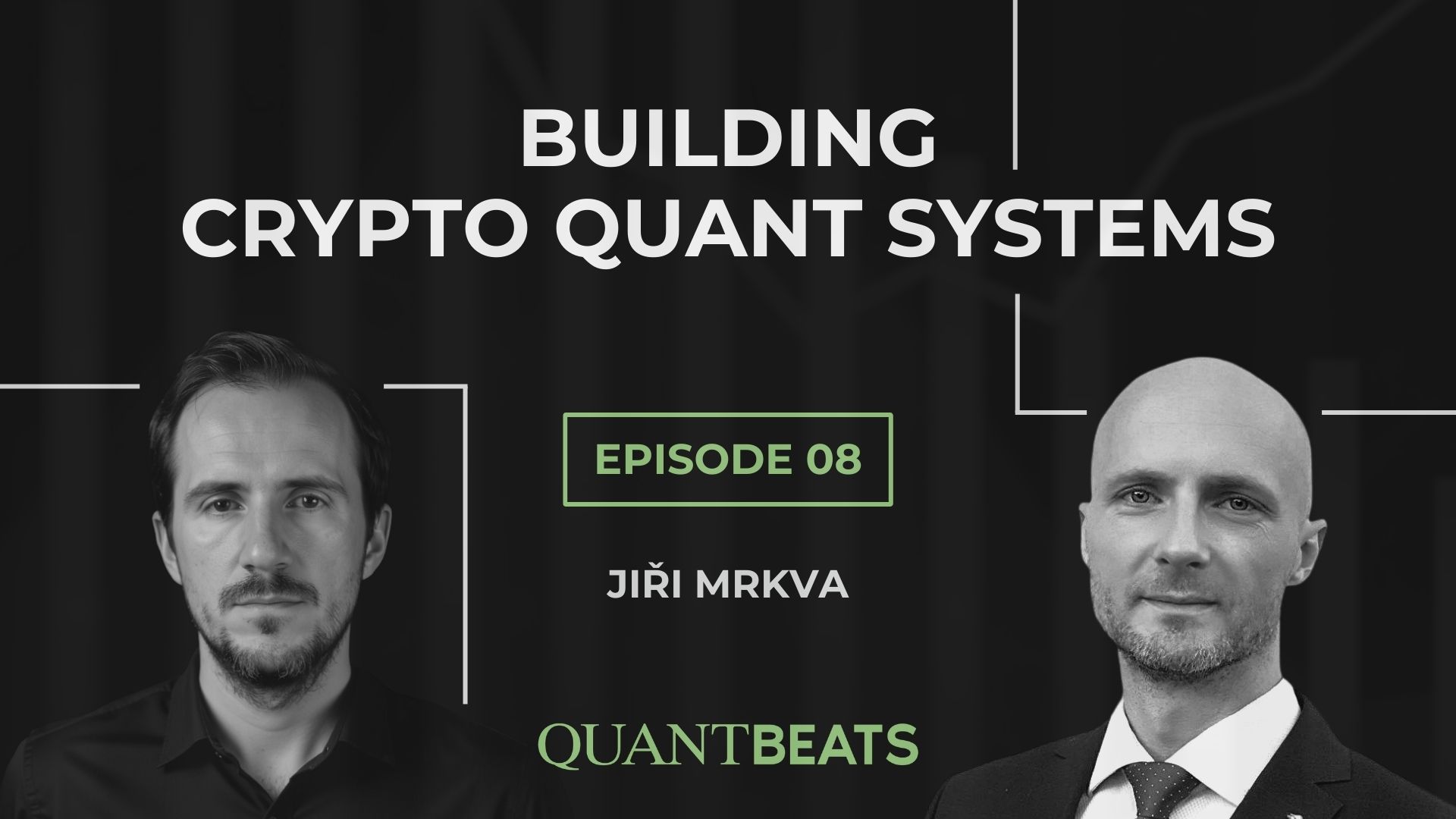
QuantBeats Ep. 08
Jiři Mrkva: Building Crypto Quant Systems
Discussion Points:
- What it takes to build crypto quant multifactor models and market-neutral strategies.
- Why automation beats emotional decision-making.
- How systematic crypto trading systems can do the work for you, how quant models can adapt dynamically, and how investors spend less time watching charts and more time living their lives.
Listen Full Episode Here
Watch Full Episode Here
Dan: Hello and welcome to QuantBeats. I’m Dan Hubscher, managing director and founder of Changing Market Strategies and your resource for all things Quant. My co-host is current QuantPedia CEO and head of research, and former 300 million euro quant portfolio manager, Radovan Vojtko. Say hello, Rado.
Rado: Hello. Hello everybody.
Dan: Click that Q logo in the corner of your screen to hear our backgrounds in episode one or check out the QuantBeats website. Now we welcome our guest from Link.Investments, Jiři Mrkva. Please just give us a Hello Jiři. Hi
Jiři: there.
Dan: Thank you. Now, before Jiři takes us through the fundamental discretionary versus quant systematic decision set and what all of that has to do with crypto strategies as a registered representative.
I need to show you the disclosures on the screen now, and at the end of the episode we’ll be giving you ways to contact me if you have questions for any of us about anything you have heard here. Okay? Let’s explore quantitative finance and crypto. To help investors, quants and anyone just curious to gain new insights into quants strategies, market dynamics in the future of algorithmic trading.
Jiři, can you please give us the one minute version of who you are, who your firm is, and what you do there? And then Rado will take the discussion deeper into your background.
Jiři: What I do is automated systems that are focused on the algorithmic trading using your quantitative strategies.
And I got into the Quant for a simple reason. I wanted to have more freedom and fewer daily decisions, not because I wanted to do less, but because our markets are really sometimes messy and volatile and too many decisions can be made within the day, and they need to reduce the noise that I need to react to.
So basically the approach, it gave me a repeatable process. I can do my things and when the systematic approach is operating. While I sleep is the big advantage that I can leverage. In the case of the, any instruments that are used the strategic approach with the systematic systems are always giving a big advantage, especially when there is a possibility to be market neutral and not have directional bias.
So my name is Jiři Mrkva. I’m from Link.Investments, and we do SMA trading curve on the client’s exchange accounts. And those are non-custodial. We specialize in the crypto markets.
Dan: Very good. Okay. Thank you so Rado over to you. Please take us away.
Rado: So thank you. Thank you Jiři. Thank you for a quick introduction.
I especially like the part that you mentioned that you like to do systematic trading because you want to simplify this. That’s one of the reasons why I also do the quant trading or why I did the quant trading. For me, it’s significantly easier to do the quant than to do the discretionary trading.
And is, less stressful. So I like this part. And I have one question. I would like to start with the question why crypto? Because there are so many assets that you can trade and you can start with treasury bonds, you can continue with equities, go to futures, et cetera.
So why crypto? I like that we have the crypto guy here in, in our QuantBeats podcast. But why crypto?
Jiři: Yeah, that’s a perfect question. Flexibility, freedom, web3 and the new approach to the finance that would be simpler answer. Systematically to have approach and to invest in cryptocurrencies gives big advantage, especially when you have a broad market.
And there can be a lot of advantages. Also, disadvantages. My decision mainly to focus on crypto solely is for their fundamental value that it can be used out of the system, not specifically going out of the law or let’s say avoiding anything to leverage the technology and the finance, which are really drive for any innovation.
And I like not only the technology, but also the flexibility that comes along with the such a systems. So that’s why crypto. Plus Bitcoin and cryptocurrency started my investment journey on completely different level. So that’s why I take this challenging market as the part of my business journey and also the private journey.
Rado: What I think is that you probably like that the crypto is not so entrenched as the traditional finance, so it’s easier to start something in a crypto then in traditional finance with all the regulation and etc. etc.
Jiři: Correct. Yeah. That’s the part of the journey, but definitely that’s the main advantage.
Dan: Jiři, when we met, we talked a little bit about the market, but we talked a little bit about your life and I was interested in this and I think other people would be very interested too. I understand that what we’re going to talk about is the potential flexibility of the opportunity set in crypto. That I get. And that we’re going to talk about how quant systematic systems are simpler from the quant point of view. It’s an argument to be made. Not everyone would agree, but we would say that as quants, and I understand that the system is simple, but I was intrigued with the effect on your life. Why was it that you wanted the flexibility for yourself?
Why was it that you wanted the simplicity for yourself? How do we relate to these highly technical systems in that way?
Jiři: Thank you that you brought it out. It’s something that, it’s really part of myself. I’m focused on the really simplicity within a live and only things that matter I want to focus on. I want to be dynamic and flexible to decide anytime on the thing that I want to do and when I want to do it.
So the time and flexibility is the core fundamental of human beings in general, and I think sometimes feel like I’m amplifier of the human being. So I have this, intention to be flexible and to be dynamic and to be in motion and really active in any aspects of life. So I came up with this concept like I can do anything that is going to be helpful for me and others from anywhere in the world with any almost device.
So that’s why the technology itself involved in, and that’s why the system that we have is focused in this particular way. To get the clients possibility and ability to have their own assets in their own accounts, in their own exchange, on their own custody, to segregated managed accounts where they have this operational flexibility and everything.
Only after the result is happening, then we are in a win-win situation. So this type of flexibility is coming internally from myself. We spread it across a team of ours. And also that’s part of our mission to deliver the highest possible value to the people who wants to have the same flexibility and dynamics as to save a lot of time within the investment journey. So that’s how this is really combined everything.
Dan: Okay. That’s interesting. I might agree or I might disagree if I’m an outsider, if I say that in a market like a currency market or like a cryptocurrency market. If there’s opportunity and risk trading 24/7 around the clock, in a market that’s filled with technology and fast movers, I feel like in order to capture the opportunities I have to be in front of the screen all day long. I can’t go to sleep, I can’t go to the gym, I can’t go to yoga. How does this combination of market and systematic approach fit in with that need to be on all the time?
Jiři: I want to have the highest quality and the best possible result all the time. I can trade myself. I need to give some sort of automation to the system and the decisions. I need to create my own decision upfront. That’s why I want this to be automated later at the certain conditions that are within the market when there is opportunity. So the systematic approach is just amplifying this idea in more broader concept and really sophisticated way.
It gives the opportunity to naturalize and to profit within the market when there is certain opportunities while I’m sleeping, while doing fitness or having jogging time with my family, et cetera. So those are the times that I want to live and I want to spend my time with normal living, which touches everybody, including your portfolio managers within the mid-size and large companies.
So this is why I need to have these systems to be automated and fully aligned within the frameworks and concepts and the portfolio systems, and also the regimes, how they are designed and how they’re prepared. So there are specific rules, how the system is going to behave, and if any rule is outside of this range, then we know that it’s something wrong.
But the system is designed to repeat all these actions systematically when the certain conditions are happening so we can have more smiles and we can have more fun within our life, and the systems are going to be helpful. It’s a nice journey, I need to say. Nice journey to be part of that and to build systems that are making a lot of positive and it’s growing and evolving. That’s the reason why I’m in.
Dan: So you’ve used the technology to help you so you can go out for a jog or spend time with the family and it’s making decisions while you sleep, but presumably, and I know we didn’t get very much and we can’t into the specific way that your customers use the system, but presumably the technology is there to help them as well so they can do these things.
Jiři: Yes, definitely. That’s why we are there and to scale up the system into the way they can leverage our solution in their advantage.
Dan: The technology is there to capture the opportunities, but also to help us sleep at night.
Jiři: Or be faster or more efficient.
Dan: Yes.
Rado: No, but if you do not want to be discretionary trader, that’s the only way because otherwise you will stay 24/7 and you will have to, watch the chart and do it by yourself and you don’t want to do that.
You want to have a life, you want to go outside, you want to have a fun. So that’s the reason why people are quant traders and not discretionary traders.
Jiři: Hundred percent agree.
Dan: So become a math nerd to, in order to have a life counterintuitive, but it’s true.
Rado: Okay, because you are, or your company trading the crypto systematically, what does it mean? You are running multiple strategies on multiple crypto underlyings or just on Bitcoin or how does it look like on the higher level? Or what is your approach?
Jiři: To clarify everything about this part.
The crypto itself and the systematic approach is important for us because of the ability and flexibility and wide range of different pairs that we can trade. We focus on the larger liquidity pairs with the largest crypto exchange, such as finance, where we can focus on the different pairs based on the different models.
All of our models are quite flexible within the, let’s say, our flexible approach is giving us the possibility to choose different models that has the different level and different range of portfolio. So we have the broad approach within the selection of different or specific pairs. For the models that we have applied and with did we use within our trading systems for the quantitative approach. We are trying to be as broad as possible within our universe for this particular systems that we use, while having not directional bias and using market neutral statistical arbitrage system that is not easy to manage,
but it is definitely with a lot of challenges, but also with advantages. So we have a broad range of the portfolio and we can trade at one time close to 150 pairs. And we have two models that are able to focus on the trading less than, let’s say, 40 to 30 pairs. And the ones that are strictly focused on top 15 or top 20 maximum for the purpose of the liquidity.
And defining the right weight adequately to the execution and adequate outcome from such a portfolio setup.
Rado: Just to clarify, so if you are speaking about the payers, you mean the crypto to stablecoin something like USDT or you mean cross payers like Bitcoin to Ethereum or Bitcoin to Ripple.
So you mean the crypto tool stable?
Jiři: Exactly. Yeah. BTC to USDT, Ethereum to USDT and so on.
Rado: Okay. Yeah, I understand. So you have system, how to take the, all of those 150 coins and then you select gradually like 15 that are the most interesting, or the systems will trade those 15. Systems are as good as the design and the design depends on the predictors. So, What are your predictors?
So are you trying to base the decisions to buy or sell on alternative data or price action or, what are the predictors?
Jiři: The predictors are specifically within the multifactor system. We try to get as many factors as possible. Those factors are with the simple predefined metrics that are used, and we try to have as diversified portfolio of those factors and with the maximum 0.5 correlation. We are putting them in a way that we want to have at first the broad range of those factors with the low correlation and give them the equal weight. Or the decision within the model and within the trading system.
Rado: Okay. And are they mainly price based or, do you use also some networking information like number of accounts, et cetera, et cetera, like alternative data which are connected to crypto? Or are those factors, only price based?
Jiři: Alternative data are used within the system as the secondary layer to support the primary input, which is the micro structural inefficiencies within the market movements. So we monitored that on the high frequency level. While trading is on the medium frequency side.

“Alternative data are used within the system as the secondary layer to support the primary input, which is the micro structural inefficiencies”
Rado: And here is, the question, so this is like the common structure, how the market neutral funds are, I mean, structured for the crypto trading.
In the case this is the setup and there are like more and more funds coming into the crypto space. So the number of the opportunities may be shrinking. How the crypto will develop in the next three to five years regarding the efficiency? So how do you see, what do you have probably to do to stay, on the top, to still have the same level of the prediction ability as you have at the moment?
‘Cause it’ll probably change in the future as the more and more investors and more than traders, especially sophisticated, will enter the crypto market. So it’ll start to be similar to, I don’t know, let’s say non crypto markets like equities and futures, et cetera, et cetera.
Jiři: The main drive would be taking into the consideration what we really can assess from the perspective of the datasets that we can gather. What is important, how the backtesting can force us to modify our weight between the different models while not reacting on what’s happening.
It’s not going to work. So we need to, although a lot of different quants systems are updated on noted frequently, let’s say quarterly basis, this is something that needs to be flexible. And flexibility is our main domain, and we can update our systems very flexibly, very efficiently based on the triggers of our multifactor systems that we have.
To have the signals that are giving us the information and the confirmation that the liquidity is in selected rating, that the market is going in certain way against the model that we have built. Quarterly basics, updates of the models are not going to be really helpful in the long run. So monthly and more flexible and more efficient.
And very agile approach of the quantity needs to be for the model revelation and the modification because of the fast market overall within the technologies that we have, the AI and the algorithms. So it’s my opinion on that, how it’s going to develop and what is going to be real helpful as a approach.
Rado: Yeah. And what will be the impact of the AI, on all of that?
Jiři: The AI itself, I see their extremely steep curve of speed of implementation of different variables within the systems. Because what’s going to really happen that we can learn much faster. We can implement much faster. We cannot rely on elements.
We can rely on them based on the thing that they can do for us faster, but we need to be able to control them and we need to be able to check their outputs. If two systems that are almost autonomous and quite smart within their possibilities of the decisions, they can make a lot of not systematic outcomes that will cause the main problem within any implementation for for example, the quantitative strategies. So it needs to be controlled in the middle.
[With AI itself, I see an extremely steep curve in the speed of implementing variables within the system]
Rado: You are probably using the AI at the moment, as I know from the discussion we had before.
Jiři: It’s the helping layer for the gathering the data. Yeah. Not nothing that will be touching the trading at all.
Rado: Yeah. Okay. So for to gathering the data. So it’ll be always doing something like helping you to shape the system themselves. But at the end there will be still human overlay that will to manage if the system is, I mean, connected or not.
Jiři: The hard work needs to be there. So.
Rado: Here’s another question. As we are in the crypto space and we are discussing the quant development, I mean, there are like two competing ways how to wait quant systems in the multi-strategy funds.
One of that is to, give the equal weight to all of the systems somehow. So what does it mean is that, either you just give the equal weight to all of them, or you calculate something like what is the risk and you give the equal risk to all of the systems in the fund. Or there is another way that from other funds prefer, and it’s to, I would say it discretionary, try to find which systems are fit for the current macro environment and change, which systems are employed at which time. So it means, you would just do not trade a system itself in isolation. But on top of that, there is another model like macro model, which is, guiding that, yeah, this is the system which is, the better for the current macro environment. And this is, the system which, the weight will be lowered or something like that.
What is our point of view on this? Because this is not nothing which is solved. There is like competing arguments on both sides.So one side is more interested to, give all of the systems the same space. The other side, likes to very quickly remove the systems, I mean, change based on the macroenvironment.
So what is your take on that? I’ll give you the direct example. We are taking this episode at the beginning of the January and few days ago, we had problems in Venezuela. The Trump was able to get Venezuela as president out of the country. I’ll say diplomatically is at the moment thinking about, getting the Greenland under the US umbrella. So there are some political movements, et cetera, et cetera. And the question is: Is it somehow impacting, how you view your systems? So are you thinking about the higher volatility to remove some of the systems from the fund, adding the others or, you will leave it at is it is.
Jiři: So you are asking about the discretionary approach with the how to manage the models within the risk, and like this model is more risky, so I will switch it off or I will decrease the exposure or its weight et cetera.
No major amendments, changes, modification had to be done. What we significantly can say about that’s the dynamics and what we are experiencing, that it really doesn’t matter if it goes up or down.
It’s just about what’s the drawdown happening how quickly it recovers. Also, the recovery ratio, let’s say the shape index. That from the drill down recovery, this is, declining slowly and past recover or opposite. So those are the details that are really important for us to focus on the type of decline efficiency dynamics and how it can be predicted. If any imbalance within those predictions within the model are occurring. Then we implement the strategic approach to decrease the exposure based on our predefined setups that we have built within the options. So this is a prebuilt, systematic approach on the systematic systems between the different models that we use.
And we are trying to be prepared for different scenarios to know exactly what’s going to happen. Because if we are not going to do that like that all the time. Then we might be exposed to the new information to the decision maker within the quant team, quant lead who will be affected by this information that is making some emotional decision, which is affecting the overall strategy, which is bad.
So it needs to have the systematic approach with the scenarios as to have a plan, like in any case, when you have complex technological thing like airplane or spaceship. So we need to have, for any case, any plan that is going to be followed based on the rules and the statistics and information. There are exceptions for the situations that are not within the list or that are breaking the inputs of such strategy that we have, which are not happening of really, so something not causing extremes within the market, not extremes within the our plan, then we don’t need to change and we don’t need to be negatively affected. So that’s the approach of ours. It takes much more time for the preparation where we have the data that are helping us out with these type of conditions. And then we need to remodify and restructure the strategy and all these plans based on the new inputs that we have.
We are doing that as the preparation. We are not reacting, we are preparing upfront.
[If predictions become imbalanced, we reduce exposure using predefined setups]
Rado: I like this. So if I can rephrase that. So what does it mean is that, if you have like the list of 15 systems and they are running, you need to have the one system on top of that will guide when to remove the old systems that start to deteriorate and how to add new systems, into the whole structure as it’s. And here is the question. As we are discussing how to react to macroeconomic situation, how to add new systems, how to remove old systems. What are your rules to remove the system? So when do you remove the system?
Jiři: Okay, first of all it comes from the decision on the quant lead and the quant team that is built between the system.
That those are the rules. Where we can have a certain situation within the market that we can consider, okay, as a big impact, potentially not only the hard data, besides only really the statistics and information from how the model behaves on the situation that already happened. Not assumption. So specific data.
Rado: I understand, but what are those hard rules? So it’s like the system has higher drawdown than we had in the past. The equity curve of the system is flat or it doesn’t recover from the drawdown so much.What are those important statistics that you are looking at and you think are predictable for the system?
That it’ll not be working as well as it was working in the past?
Jiři: We focus on the drawdown job ratio. And returns where we have similar factors that are predefined with as broad as I mentioned, portfolio of different factors with a low correlation that we focus on the drawdown and risk of the drawdown.So for example, drawdown starts to increase to 3%.
We have the plan how this is going to be modified. Then the increase is going to be to the 5% drawdown. Then we have the other set of the rules. And every percentage point increased is triggering the other layers of the protection within the system for the market overall models to be sufficiently operating well within the market condition that’s happening. So we mainly for the drawdown at certain layers.
Rado: Yeah. Understand as we are discussing about, how the systems die normally the question is if you have 15 systems that are running now, how many of them would, under the normal circumstances, die over the year? So how often or how fast do you need to develop the new one to change the old one? Because if you have 15 systems over the next year, some of them you’ll probably die, so you’ll need to remove them. What is like the rate of deterioration that you’ll see in your data? There are always in the funds, but the question is, what do you see in your data?
Jiři: Our data says that the core model is well designed. And what we need to cut is the portfolio and the universe that needs to be modified based on the liquidity that we are dealing with. So this is the core part that the system itself is working on the right pairs if given enough weight. So we are adjusting the weight based on the information from the specific model that is designed for the particular portfolio.
Where the system itself is adjusted on the minority levels, and it’s not reducing, and we are not reducing any models within that core structure. It’s small modification and we are only reducing number of pairs. So really the model that we use, models that are used from its core and they’re built on the multiple ones.
So let’s say 20 models that we have within this, the range and what are the main differences are the ratios and the weight within the different portfolios that we measure. So we don’t see in our data the need to cut the model for its core feature, mainly for the reason that it’s on the portfolio based differences.
Rado: Okay. And are you adding more factors into the overall system?
Jiři: Dozens of factors that are built within that. Yes.
Rado: So it’s more like one big multifactor system and more and more factors are added as they are researched and found, et cetera, et cetera. It’s growing systematically. So the old factors are not removed because they have always the added value to the whole system. But as the new ideas are developed, they are added into the whole structure, if I understand it correctly.
Jiři: Exactly. We keep those factors with the correlation zero five between each other. None of these factors don’t have any correlation. More of those are giving more edge. That’s the alpha how we are doing it.
Rado: yeah. In this case it makes sense because, those systems are not individual. What does it mean is that they are treated like a factors and the more factors you have in the whole system, or meta system itself, the better they are. It makes sense. Okay. As you are running like multifactor model in this case, there will definitely be some of the factors that are probably most important or subset of the factors. From your opinion as a quant. What are those factors that are most important and are the best in explaining or predicting the movement of the cryptocurrencies, et cetera, et cetera? If you pick five of them, what it would be?
Jiři: The main constraint within those factors to deal with the liquidity itself of the particular portfolio.
We have the correlation to the liquidity. That’s how we use the symbolic factors to define how to avoid the liquidity correlation that would be answering most of your questions related to that, focusing on the microstructure, of course, movements to not to have directional bias, plus to be on the maker’s side.
“The main constraint within those factors is dealing with the liquidity itself ”
Rado: This is the bright idea because how are the cryptocurrencies correlated to the overall liquidity of the crypto market is definitely one of the important factors how this cryptocurrency is moving. You said before that, I mean you are targeting the pairs that are most liquid. I understand that because it’s easier to trade the most liquid.
On the other hand, what I see in a lot of the systems is that as the pair or any asset is less liquid, the bigger, I would say, opportunities are there. Because there is lower efficiency. So the question is how to pick correct spot between the liquidity and efficiency? Is it better to trade liquid crypto stuff, even that efficiency is higher? Or on the other hand, trade, the stuff that’s, not so liquid, but on the other hand, I mean, they’re maybe higher opportunities or bigger opportunities?
Jiři: For the liquidity. You need to have a big weight, and if you are trading that with multiple times with the smaller size, smaller exposure, you have a problem solved.
Depends how many touch points you need in order to get in and out. And it’s your question would be important to be backed by the frequency. So by the frequency itself, how often you need to make something, if you pay the exchange, et cetera, transaction for costs. And so on. It’s not coming from the size. It’s coming on the frequency related to the release system that you want to apply on this particular portfolio or particular pay coin. You don’t need to measure or combine only the liquidity and the, let’s say, balance, the liquidity and the efficiency. You need to look at the, what’s the amplitude of the volatility that you can use in your advantage within the frequency that you can apply. That you can be so enough fast on, for example, mean reversion, that you can use those data within those touch points that you need in order to make money and to be really effective and not to be eaten by the commissions.
Rado: Yeah. All right.
Dan: So can we sit here for just a minute on this point?
’cause this is a great one. And simultaneously explain these liquidity and efficiency concepts a little bit more for people who are not quants, but also show for people who are not familiar with crypto as much as tradify. How this consideration, this decision that you’re trying to make, the decision making process is so similar in crypto versus traditional finance.
Meaning, as Alda said, you’re trading off liquidity, which is participation in the market, which gives you the price that you want. When you wanna go get it, which also makes the market efficient. Prices quickly move to reflect the value versus other way around. A highly inefficient market gives you a big spread so you have potentially a high gain, but also low liquidity.
Low participation means it’s hard to get the price that you want when you see it, and you’re trying to balance between those things. And that’s true in tradify and statistical arbitrage. It’s true in crypto. So just tell us, in terms of crypto, how do you think of, what’s the definition of liquidity? What’s the definition of efficiency? Let’s just start there.
Jiři: How effective am I when I am doing certain action?
Dan: Yep.
Jiři: To the non quant explained, when I’m trying to use my energy and to move something from the point A to the point B, where there should be a bond, but there is not a bond it’s on a ladder.
I’m doing the same thing. When there is no liquidity, the efficiency is zero. So I need to have something to work with in order to be efficient. So that’s why I need to aim in the right direction. So this is the core part. In simple way I can give a lot of energy out and I’m not pointing on the right direction at the right time and to doing in the place where it’s liquid efficiency is zero. Did I answer your question, at least partially?
Dan: You did. So I’m just trying to draw out a bit more detail with respect to Rado’s question, which is how do you make the decision and the trade off between high liquidity, high efficiency, but lower price dislocation. So lower profit opportunity versus lower efficiency, lower liquidity, but higher return potential because there’s higher dislocation on the price. How are you navigating in between those extremes?
Jiři: Yeah. That’s why the market neutral comes in play. It gives more opportunity because you are not directionally biased.
And you are using the data sets in your advantage which gives you the opportunity to operate at the right time on the right asset.
The biggest risk is that you are doing it for nothing and you’re losing instead of making money. That would be the part of getting to the right point of assessing these multifactor models that are multifactor information and data sets that are used to naturalize and to making a profit on the models itself within the models on the portfolio that was used. To clarify that efficiency within the combination of the liquidity at the right time would be important to adjust weight between the factors that are built. There is only way, in my opinion, that’s within the flat approach, where as the traditional quants are doing that all the weights within the models are flat, giving the bigger weight in order to give the chance to do, let’s say, higher caps which are naturally having bigger liquidity.
Is giving the feedback on the efficiency that is going to increase. If this is going to be confirmed within the performance of the system, then it should be confirmation that this is the efficient way how to operate. Then the weight between those models would be adjusted accordingly. So you don’t need to modify the core model or different models, just the different weights.
So that’s why the dynamic approach within the standard quant models to have a equal weight everywhere would be giving the enough flexibility. That’s our domain. So the approach would be, in this particular way, to increase the efficiency through the small change, it will give you the feedback. And then you can create a loop and to modify and create even more profit or positive feedback based on the market reaction.
So that would be one of the approach that would be significantly changing the behavior and stagnant.
Rado: Then, just to rephrase, so what I think the Jiři is trying to say is that, at the end, you do not need to make that trade off between the efficiency and the liquidity. Because at the end, the model itself, as it behaves, it’ll naturally move where is the best for it. If there are the biggest opportunities in the highly liquid, highly efficient cryptos. Yeah. Whatever, you can trade that. If the higher opportunities are in the lower one, you will move to the lower one to less liquid and less efficient. So at the end, we’ll leave it on the model itself.
Dan: So these considerations are, I think, similar between crypto and traditional asset classes, say equities. But is it that in crypto there’s more flexibility to achieve these opportunities than in other asset classes?
Jiři: Absolutely there are a lot of risks involved because of the new projects that are listed.
And there might be something in the background, hidden, so it’s not regulated, so it can be issued and it can look perfectly on the outside. Inside it might be broken with fake wallets, et cetera. So the fundamental analysis is going to be helpful. But not for all the cases. So there are opportunities and there are also risks involved.
So that’s why the time aspect to have certain coin or portfolio to give you the time to see how it’s performing, how stable it is, what’s the community, et cetera. All different benchmarks and the metrics within the assessment of the stability and the strength of the certain pair will give enough confirmation.
And not only, but also those are the factors that will give us some indication that this is going to be stabilized. Although we saw certain coins and exchanges that collapsed really quickly in the past. So those are the aspects how to really work in this particular way to assess what is going to give opportunity and give portfolio that is built within our broad range of the universe on the Binance exchange. It is, for example, used for the specific strategies that we have.
So we need to combine. Not only the fundamental information, but also time wait and how long it’s in the market, how it behaved in the certain conditions and certain market behavior because it’s still growing and there are more and more pairs that are really interesting. But the price is not everything, important is stability ,Predictably expectations that are squeezed within our scenarios.
“price is not everything, important is stability predictably, expectations that are squeezed within our scenarios”
Dan: Okay.
Rado: I like how you said it, Jiři, because I think this is like the main difference between the traditional finance and crypto. Meaning in traditional finance, if we are discussing the stock picking, you are creating the stocks, you are looking at the fundamental data.
But the due diligence is not so important because at the end, those companies, when they want to enter the exchange, they must be regulating. They are heavily regulated, so it means that there is a lower probability that there will be some problem, like legal problem or anything. But the crypto market as it’s is emerging and it’s still plus or minus the emerging asset class. The number of the coins that are, let’s say the fake or the projects behind those coins are not real, the percentage of those projects that are significantly higher than in traditional finance.
So I like your comment that in the crypto it’s still important to do the due diligence.
Even when you are trying to build your portfolio, of the assets that you consider to trade.This is something that we forgot to do in the traditional finance because we do not need to do that so much because, we are not afraid so much. 20 years ago there was a Enron and it was like surprise for everybody.
That yeah, it can happen to even the big company that there is a fraud, but we are not so used to frauds then the guys like you, Jiři, are in the crypto market, are used to, so what does it mean is that you are right that before you start to do the quant trading, you need to consider the due diligence of the coin.
You would like to quant trade. You can be want only when you have a portfolio of something, which is not the fraud. I like this part. This is something that I do not pay a lot of attention to because I do not need to.
Jiři: You don’t need it? Yes.
Dan: Okay. Thank you very much. I think we gotta let everyone go for the day.
So thank you very much, Rado. Thank you very much, Jiři, for being our very first crypto quant on the channel and teaching us how to make our lives simpler and flexible. So to everybody listening, if you want to meet Jiři from Link.Investments, if you want to meet Rado from QuantPedia to join us as a guest or if you’re interested to otherwise support the channel, contact me Dan Hubscher at the details shown here.
Just note that any questions regarding investment offerings will be deferred to an email follow up for compliance purposes, as these videos are not intended to be about investment offerings. Okay. If you like this video, please do come back for our next interview with a quant manager guest. You might also wanna watch the other videos on the QuantBeats YouTube channel, so don’t forget to like, comment, and subscribe to QuantBeats on YouTube.
Again, you can get there via that Q logo down on the corner of your screen. Or finally, you can visit our websites and YouTube channels for more shown right here. Okay. Thanks for joining and wherever you are in the world, have a quant day.
Rado: Thanks, bye. Bye everybody.
Jiři: Bye. Thank you so much.


