
David has over 19 years of industry experience and worked with quantitative strategies before entering the financial industry. He always looks for efficient and effective ways to grow assets using equities. His passion is value investing, but his focus is on quantitative, automated, and unbiased approaches…more
QuantBeats Ep. 09
David Kaiser: The Process of Quant Value Investing
Discussion Points:
- How systematic strategies use predetermined rules to strip away bias and prevent overreactions to macro crises.
- Why resist the urge to trade all year, and rebalance annually in early January?
- Where to find the common ground between quantitative portfolio managers and investors who need the narrative on companies.
Listen Full Episode Here
Watch Full Episode Here
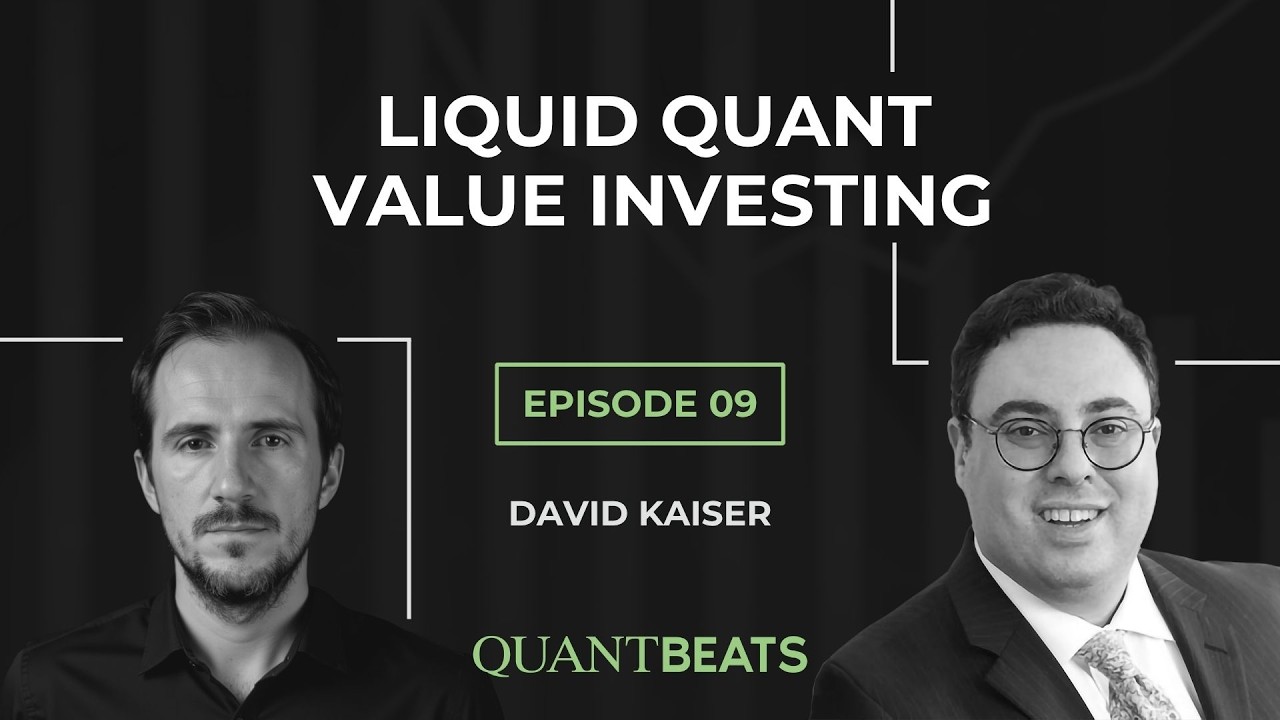

Dan: Hello, and welcome to QuantBeats. I’m Dan Hubscher, managing director and founder of Changing Market Strategies and your resource for all things quant. My co-host is current Quantpedia CEO and head of research, and former €300 million quant portfolio manager, Radovan Vojtko. Say hello, Rado. Hello. Hello, everybody.
Now, I want to give a warm welcome back to our returning guest from Methodical Investments, David Kaiser. Please just give us a hello, David.
David: Hello.
Dan: Thank you, David. You might remember David from episode seven, and you can find it on our channel. So today, this is episode nine of QuantBeats and episode two in our series with David on quant value investing.
Therefore, today we’ll pick up on some themes from David’s last visit and dig a bit deeper on those to build that bridge between fundamental discretionary value investing and quant systematic value investing. But first, as a registered representative, I need to show you the disclosures on the screen now, and at the end of the episode, we’ll be giving you ways to contact me if you have questions for any of us about anything you have heard here.
Okay. Let’s pick up where we last left off with value investing to help investors, quants, and anyone just curious to gain new insights into quant strategies, market dynamics, and the future of algorithmic trading. So David, for anyone that hasn’t seen your first episode, can you please give us the brief version of who you are, who your firm is, and what you do, and then Rado will pick up this discussion from there.
David: Sure. So I’m David Kaiser. I run Methodical Investments, and we are data-driven, fundamental, and rules-based value investors.
Dan: Great. Okay. Thanks very much for that, and we’ll get more into it as we go. Rado, over to you.
Rado: So thank you. Thank you, Dan, and thank you, David. I mean, being once again a guest in this, in this podcast.
So I will probably jump straight into the point. As we are recording this video, I mean, it’s beginning of April, we still have a conflict between Israel, US, Iran, and the rest of the countries in the Middle East. So I mean, there is- it’s like a mess. This video will probably be live at the beginning of May.
We have no idea how the situation will look like a month from now. However, we can say that, there is a stress in the market at the moment. There is stress in energy market, there is stress in equity markets. I mean, there is stress everywhere. So what is the impact on value strategies? How are they impacted by this stress?
What should we do as quant value investors? Should we somehow react to the situation or et cetera, et cetera? I mean, I’m not happy that it’s happening, but I mean, it’s great to have you here, and I can ask these questions, and they are relevant.
David: A couple things. I think one of the beauty – beauties of being a quant investor is you’re sticking to the data.
And there’s going to be external factors, macro, micro, there’s gonna be wars and presidents doing things, and companies doing things that you don’t expect. There’s always gonna be something that you don’t expect, right? So one of the beauties of being a quant is that you are sticking to the numbers, and you have an idea of what you’re gonna do in different scenarios based on that, not based on predicting what the President of the United States is gonna do, not based on reacting to a situation and trying to understand, like, well, okay, is this war the same as it was in the last Middle East war?
Or energy prices are going up, is that the same as we had last time energy prices went up? Or no, another time. Like, instead of trying to figure out how to react and how to figure out what might happen next, we’re just reacting to what’s happening, and predetermined rules, relying on the data, removing that bias, and that tendency we have to react or overreact.

“Instead of trying to figure out how to react and how to figure out what might happen next, we're just reacting to what's happening,”
Now, when you react strongly to something, you can either be dead on or really far off, right? That’s usually what happens. So I’m not saying that we’re right every time by being quants, but we’re consistent in what we do, and I think more often than not, that will work out well. The other point is yes, kind of about value and quant and how is that working.
I think in times of stress, especially when you see a market that’s potentially overvalued, people will gravitate more towards, quote-unquote, “safer equity investments.” You know, what something’s worth today, not just what it might be tomorrow. You can see that this year when you look at the value indices doing noticeably better than the other indices this year.
So I think times of stress, not that you want it, you’d rather see an environment where people are being rational and going to value for the right reasons, you know, which are discounted companies, quality companies have better risk-reward profile. But in an environment like this, I think people pay more attention to that, not necessarily for growth drivers, but from a defensive position.
Rado: Yeah. When you are running quant value portfolio and there is a stress, I mean, what you can expect is that there will be significant difference in the performance of individual companies that you have in the portfolio. And the question is, I mean is it a good time to rebalance the portfolio? Or, I mean it’s better to leave the weights as they are?
Because, I mean, some of the companies can go up 30% and some of the companies can go down 40%. So I mean, there is, like, significant discrepancy, what are the prices, what is the value, et cetera, et cetera. So I mean, what to do? Is just the rebalancing a good idea to some default values, or how to proceed?
David: The way we look at it, you know, is the portfolio still discounted? And are we diversified enough? Which is a general approach we have, is to stay diversified so that we’re not relying on any one security. And so by doing that and sticking to the numbers, I don’t think you need to rebalance, and I think in some cases, rebalancing outside of your normal rebalance period, you know, because of a catalyst or something that’s happening like a macro event, why deviate from something you know works over a period of time because of an event that, frankly, is unpredictable. The war could be over tomorrow, we don’t know. If you have in your strategy to rebalance on periods of stress, that’s fine. We don’t have that. We focus more on the data and what the portfolio looks like in aggregate, and if our portfolio’s still discounted and has good quality metrics, we’re not rocking the boat.
“We focus more on the data and what the portfolio looks like in aggregate”
Rado: Yeah, I understand that for value, it takes a longer time to realize the price appreciation because, I mean, it’s not like the momentum, so they are buying the stocks that are going up, and you need to rebalance the portfolio very often to, I mean, still have the winners that are the winners because the winners tend to be the winners for, I don’t know, a few months or something.
For value, you need to wait patiently for a longer time. So what is, like, the optimal length of the rebalancing for the value portfolio? So if I have a value, how long does it usually make sense to have the stocks in the portfolio, and how often does it make sense to rebalance? So I understand that it doesn’t make sense to rebalance right now because it is stress and it’s out of the rebalancing period, but, I mean, what is, like, the ideal rebalancing period for the value?
David: So, you know, I will say I think that it can be variable, and I think it’s relevant to what your strategy is and what you find works for you. We found that roughly a year rebalance works very well, and that way we’re keeping the portfolio discounted, and if it moves up, if there’s any deterioration…
You know, different things can impact valuation. If that happens, by rebalancing, we’re kinda resetting it, but we’re also giving things time and you mentioned, you know, momentum, growth, things like that. Ideally, we wanna hand a value stock off to a growth investor, and it can take time for them to be realized.
So if you have something that’s very discounted, maybe it’s traded down more. There are different reasons why it could go up. It could beat on earnings. It’s perception. So if people think earnings are gonna disappear, they don’t disappear. They actually go up. They think earnings are gonna go to zero or negative.
They don’t. It’s not as bad as they thought, and there’s different reasons. There can be sector rotation. People change their sentiment, so they’re looking for alternatives in different sectors, and they realize, “Okay, this sector and this company is inexpensive.” But that doesn’t happen immediately. You don’t buy it, like you said.
You know, you don’t buy it thinking people are gonna realize tomorrow. That’d be nice, but that’s not always what happens. The idea that you hand it off from value to growth, or you find someone who, you know, obviously thinks the price is gonna keep going up, but you’re not necessarily comfortable with it on a valuation level, that’s the goal.
The way we run the strategy, we found that a year is a really good balance, a really good period. And again, being consistent, right?
Rado: Yeah. And what about the tranching? We can have a yearly rebalancing period, so I can rebalance once a year, but I can split my portfolio into 12 parts, and I can rebalance 8% of my portfolio every month.
And I mean, in this case, I have yearly holding period for, I mean, the stocks in that individual tranche.
However, as I’m rebalancing over the whole year, so I’m basically always having the one-year holding period. But I’m, I mean, rebalancing each part of the portfolio every month or something.
Is it better to use the tranching or, I mean, is it better to rebalance the whole portfolio just once a year? Once I have all of the information that I need- so I mean, the June or, I don’t know, July, August, whatever, I will rebalance the whole portfolio.
David: So two things I’ll say. One is it is relevant to stick with what you’re comfortable with and you find works in your strategy, right?
There’s no universal way to do it. What we found is, as I mentioned, you know, reasons for a year, but also we look at the portfolio in aggregate, right? We’re not analyzing each company and why is it in the portfolio, what’s the potential for each company. We’re looking at the portfolio in aggregate. So we look at it as if it’s a one-company portfolio when we look at the valuation, operating metrics, things like that.
When you’re looking at it that way, I don’t think that rebalancing monthly necessarily be helpful. The other thing that’s important is we found that if you buy in January, early January, you’re benefiting from tax-loss selling in general. In general, not in every instance. But things that are discounted, you know, have been down and get beaten up more, and that’s really an opportunity.
So there’s a little more leverage potential, and that’s another reason. So we found that rebalancing in January is advantageous, using the same rules.
“We found that rebalancing in January is advantageous, using the same rules.”
Rado: Yeah. It makes sense because, I mean, in this case, it really adds value. I mean, it adds a value into the value.
David: Well, that’s it. Yeah.
Rado: Okay. And what about the liquidity?
In this case, if I do it, I mean, once a year, there can be some tricky- to get into the position.
So how do I manage my position from the liquidity point of view, and what is, I mean, the impact of the liquidity on the value investing itself? So I mean, it’s better to buy the stocks that are less liquid because there is better value spread, or the more liquid because you can get more money into the more liquid stocks, or I mean, it’s not important decisions at all?
David: I will say one thing before I get into liquidity, which is it’s not that you shouldn’t do anything from January to December. It’s just that, you know, a major rebalance if, you know, we found a year, and again, sticking to what you know works for the way you do things. Now, you mentioned liquidity. I think liquidity is important for two reasons and in two ways.
One is for investors to feel comfortable that you can grow your portfolio without having to change what you’re doing. So we think it’s important to have liquid companies because by having liquid companies, we can grow the portfolio and not have to modify our approach. And so that’s, one is what you see is what you get, and two, you know, investors are comfortable because they know that you can scale, right?
And that’s important. And you also in quant have an idea of what that number is, how large it can be before you have to modify. It’s not a variable number, it’s a finite number. It can be. Two, there’s a difference between liquidity in the portfolio and also as a… Let’s say you run a fund. In my opinion, you want to be friendly to investors, and that means underlying assets are liquid.
And two, you can offer more, more frequent withdrawal periods for investors because of that. So they go hand in hand, and you can have an investment where you have underlying liquid securities, but you have a once a year withdrawal period. And so it’s not really that relevant. It may be relevant to your ability to get in and out of a position from a trading perspective or a strategy perspective, but it doesn’t necessarily help the investor.
And then you can have a portfolio that Can have frequent withdrawals, but if you have to maneuver and what position do you sell and what are the consequences, and that sort of thing, as opposed to a model like you would have in quant, where it’s like, “Okay, if we have 10% redemption, this is how we’re gonna do it, and we’re gonna sell across the board, and we have the model, so we’re sticking to the same percentages and that sort of thing.”
Liquidity, in my opinion, is very important from an investor perspective, and also from running the portfolio from a PM perspective, and there’s a balance. I mean, you don’t have to buy a trillion-dollar market cap in your portfolio. We’ve talked about in the past, SMID cap value is a great place to be.
So you can be liquid in that space and scalable also.
Rado: As I understand, I mean, at the end, it’s about the balance between what you promise to your investors and what you can achieve with that promise. You promise them that you will be liquid fund, you cannot buy illiquid stocks into the portfolio just because they offer a little better return.
So because, I mean, you will promise something to investor, but at the end you are not able to achieve that. You must balance.
David: And to your point on, you know, less liquid securities, there can be, like you said, a lot of leverage, but it’s gonna be harder to realize that leverage, right? I’m not saying they have to be the most liquid securities, and as we’ve talked about diversifying across names means that you can buy less liquid in a less concentrated way and have the same liquidity goals for the portfolio.
It’s not just exceptionally liquid companies because even at a large number of AUM, by spreading it out, they can be more liquid, but not the most liquid, and that’s a good balance, too. So you can still have quite a bit of leverage, still have liquidity in the portfolio that’s dramatic.
Rado: As we touched the investors themselves, how we can get investors on board to, I mean, let them understand that what is the added value of our approach?
What is the added value of value itself? To explain the framework and what are the advantages, so I mean, how we can get them to agree that what we are doing is the best for, I mean, them.
David: So I think a big aspect and especially, you know, in quant, is data. You need to be able to convey and be transparent in your data.
“You need to be able to convey [TRANSPARENCY ABOUT ] your data.”
And so as a value investor, what’s important? It’s valuation, PE, price to book, price to cash flow, things like that. Excuse me, and, you know, return on equity, other operating characteristics. Those are the things that matter, right? Those are the metrics that we look at, or some of them, I should say.
So it’s very important for investors, to have insight into what you’re doing, and also from an allocation perspective, to understand what your portfolio looks like, what your approach is, as much as you can share. I mean, obviously in quant you’re not gonna give them all the ingredients and tell them you know, how long you bake it for type of thing.
Transparent as possible in both rules, approach, you know, selection criteria, things like that, and most importantly, what does the portfolio look like. So we’ve talked about, we look at the portfolio in aggregate. You know, not that the individual companies aren’t important, but when we’re looking at what the potential is, we’re looking at a portfolio level, right?
‘Cause people are buying the portfolio, they’re not buying our top five names. They’re buying the whole portfolio. So we wanna communicate that, and I think that’s huge. Transparency in terms of how we think, but also giving them the data so they can make an informed decision. And I think we talked about it last time, you know, if you have someone who’s looking for value allocation, in my opinion, you need to be showing that you are value and where you would fit in their portfolio by quantifying how you are value.
“People are buying the portfolio. They're not buying our top 5 names”
I think that, going back to your question on, you know, macro events, doesn’t matter what I think, and we talked about this last time too. Like, it matters what the data shows and how I’m sticking to my approach, because I think an investor doesn’t wanna bet on my ability to make the right decision based on my ability to assess the situation, and also quickly, right?
You know, talking about macro events, things are happening very fast, very unpredictable. Okay. So today I’d make a decision based on the work of last two years, and it ends in two weeks. Like, what do you do in that situation? So transparency, data, the amount, the quality, framing it in terms of how you approach quant, I think all those things are important, but you need to be able to quantify what you’re doing.
Rado: Investors are different. There are investors that are more, like, fundamental based, so they like to speak about, yeah, do you have this and this company? I mean, it’s great, and do you have it in portfolio? And how much do you have of that company in your portfolio? And then there are others that are more into numbers.
Let’s tell it this way. If I’m quant value investor, so I run the quant portfolio, how will I explain to the first investor who is interested in names, and how much of the name you have in a portfolio that what is the added value of looking at it from the portfolio point of view and not just, I mean, on the individual names?
David: Okay. So the first investor, and remember, I came from a fundamental, doing research on every company, talking to manager, that kind of stuff background. So I get that perspective. It’s really painting the picture and showing the framework from how you think, and that can be a hard thing to explain to someone who understands it from a different perspective.
It can be tough to kinda show them the light, right? Like, this is how we look at it. This is why. And it’s harder than someone who comes in with a blank canvas and says, “All right, how do you invest?” And that’s not what happens, right? Everyone has an idea of, okay, you’re a value investor, so this is…
Well, yes, but, right? So it’s really getting people’s ear and creating a framework and being consistent about explaining what you’re doing, how you’re doing it. That’s one thing. And I think to the quant side of it, you kinda run into the same problem, right? Because how do you explain that you’re a value investor, but you’re quantitative because someone with a quant view may have a different idea of what that means.
Again, that also goes back to transparency and, like, what data you’re sharing, how transparent you are, how you explain, all those things are important. And I think you’re not gonna please everyone, right? You’re not gonna… Every investor is gonna be like, “Oh yeah, this makes sense.” And that’s important in my estimation to have people who not only understand what you’re doing, believe in what you’re doing, and want to be a partner in what you’re doing. And with the value portfolio, as you mentioned, you know, it’s a longer holding period, we take a longer view, things like that.
We don’t want people who are in March and out in June. That doesn’t help them, it doesn’t help us. We really want like-minded people. Not necessarily who come at it from, “Okay. Yes, we want X, Y, and Z,” but who understand what you’re doing and how it fits with them. And that you’re not gonna please everyone, right?
Rado: Yeah, just from experience, are investors listening to value proposition from the point of view that it’s a factor that offers outperformance, or I mean, that has added value? Or are they, I mean, still in the efficient market hypothesis, passive investing crowd?
David: Yeah. If you’re an efficient market passive investor who doesn’t believe there’s leverage in the market, right, and opportunities for outperformance and alpha, yeah, that’s a tough sell, right?
I mean, you can show them and they can justify why, you know, in X period you outperformed or underperformed, and how it’s gonna balance out. I do not believe in efficient market theory. I think there’s leverage to be had in the market. I can show data to show where the leverage is. Does that mean it equates to outperformance every year, every period?
“I do not believe in efficient market theory. I think there's leverage to be had in the market”
No. But I can show the data to represent the differentiation, and when there’s differentiation in terms of, in value investing, valuation, where you can show a strong discount and also quality metrics, over time that should make a difference in performance. And again, also makes it clear what they’re allocating to, what, you know, what an investor’s allocating to.
Dan: Well, that’s interesting. But I wanted to dig a little bit deeper on that if I could. I’m sorry, Rado for interrupting you, but this is kind of where it falls apart for me. What I’m doing here is I’m channeling people that I talk to, and I know where it falls apart from them. You talk about justifying your decisions with the data rather than the narrative, and I’m paraphrasing what you said, obviously.
David: Yeah, that’s fair.
Dan: If you’re talking to people that we may or may not be fairly categorizing as fundamental value investors, how much analytical capability do you expect them to have, and how much do you expect them to put that to use to crunch the numbers and say, “Oh, yeah, you’re right, and now I have faith in what you’re doing”?
David: Do you want me to quantify that number, or do you want me to just speak to it subjectively? So I’m not gonna quantify it, but I will say that it is a challenge, right? Anyone who comes to you with an idea of what you’re doing before they understand what you do, it’s gonna be hard. I think you start with, you know, where I came from, which is metrics we look at, the information that we’re communicating is not foreign.
How we produce a portfolio, how we look at it in aggregate, those might be different. Looking at it quantitatively and not having a story on all our companies or any of our companies really, like focusing on the numbers instead, that can be a challenge to explain, but by focusing on metrics they’re familiar with, that I’m familiar with, that we focus on.
You know, that’s a starting point, right? You have to find common ground. And so to say, okay, you agree that, let’s say, a discounted PE, a discounted price to book, a high return on equity is a good place to start as a value investor from a numbers perspective. And if you can show that and relate to their framework, that’s a good bridge.
I think that’s important, not to be black box, not to come at it from a, we come up with this formula that people don’t really look at, or it’s a different way to look at things, but it’s so different that people can’t relate to it. I think that’s a harder sell, so to speak. And also, if I can’t explain what I’m doing to an investor, you know, explain the reasons why I do the things I do, or at least the framework, the rules that I, you know, we’ve come up with.
If I can’t explain that, then what does that say about my process? And what does it say about its repeatability? And that’s an important thing. Investors wanna understand what you’re doing and if it’s something that works or that fits in, whatever, to a value box, let’s say, right, for them, that you’re doing it consistently, and you’re consistently in the value space.
“Investors want to understand what you’re doing, and if it’s something that works..., that you’re doing it consistently… in the value space.”
Dan: Okay, there’s a bit of an irony here
that’s constantly at play. If you ask any person in our world, whether they’re a fund manager, an investor, a service provider, technologist, doesn’t matter who it is, what kind of role they have, “Are you a data-driven person?” They’ll all say yes.
David: Absolutely.
Dan: However, I don’t know a single quantitative hedge fund manager that hasn’t capitulated into writing a prose narrative on a regular basis for their investors and prospective investors. They have to tell the story of what they’re doing, and that narrative tends to get down into the minutiae and the selections.
There has to be a reason for having something. So to, to get back to where Rado started the conversation, okay, here we are in April of 2026 as we sit here. There’s uncertainty, to put it mildly, in the Middle East. And I’m coming to you, David, and saying, “Okay, SMID cap value quant, I get it, but why is it that you have a bunch of boring lumber companies in the portfolio and you think you’re gonna have them for another eight months when you could have, you know, up-and-coming undiscovered, defense contractors that are gonna make a ton of money now?”
David: But I think from a quant perspective, the important thing is the consistency of the narrative and focusing on what’s important to why you do things. And people are gonna wanna know, well, why is X company in? Why did you pick this? Why are you not, as Rado said and you just said, you know, rebalancing now into, you know, companies that might be more advantageous now from, might be more discounted now because of what’s going on, right? Consistency in what you do, and I keep saying that word, but it’s so important, and not deviating, and having, as a value investor, that long-term view. And that doesn’t mean that when you rebalance there can’t be noticeable turnover and things like that.
But that you realize, and that patience from being a long-term fundamental qualitative investor has played into, you know, certainly the way I look at quant. And so when you look at quant from that long-term perspective, I don’t know if adjusting frequently, rebalancing frequently is consistent with that view.
I don’t know if that fully answers your question.
Dan: I understand the sticking to your knitting, but what I’m looking for is, now tell me why that’s good for my capital account. Why is that better for my returns and my risk-adjusted returns, whatever the process is?
David: Sure. Any given period is gonna be better or worse, I can’t tell you.
But I can tell you that by sticking to the data over time and an approach that you know works, you will come out ahead in the long run more often than not, right? And does that mean there aren’t investors who are able to exploit what’s happening in the market in a better way at this point?
No. There are investors who will do that. But two years from now when a different scenario comes up and they have to make a decision again, what confidence do you have that they can make the right choice again? And so as a quant investor, focusing on the data, and you wanna know today why in the portfolio I am and what it looks like, I can quantify that.
Right. If I rebalance today, would the portfolio look differently than it did in January? It probably would. But is it better or worse? I can focus on the numbers, tell you why I’m in the portfolio I am, tell you what the leverage is there. It goes back to what your narrative is, right? Because people are gonna ask questions, again, based on their bias and what, how they think it should work.
And people are gonna pick apart what you do. At the end of the day, it’s your results and your ability to quantify and share and be transparent about the data that matters. You’re not gonna please everyone, and you’re not gonna hit it out of the park in every environment. Unfortunately, you will deal with and you will talk to people who have a framework and don’t understand.
And when people don’t understand, they tend to, kind of pick apart and, “Well, why do you do this, and why do you do that?” And, you know, “From my perspective, you should do this.” How do you combat that? I don’t know completely. It’s really about, again, doing what you’re comfortable with and what you know works, and that combination when it comes to data, right, and understanding it.
If that person or that investor is coming at it from a different framework and not able to accept, understand whatever, where you’re coming from, that’s just not a good fit, and you have to move on.
Rado: In this I agree with you, David. There will be always, like, people that will come to that investing from different narrative or different perspective, and that’s okay.
I mean, so they can pick different fund or they can invest by themselves. As you said, I mean, you will not be able to please everybody. So at the end, you have a process, you stick to the process. You have the data, you have a backtest, you have out-of-sample test because you have a fund that’s live and that is running for, I mean, a lot of the years.
And you can show it. At the end, it’s up to them. I mean, if they feel that the process should be different, they can run their own portfolio, and then they can build a different process for their own portfolios. As you said, I mean, at the end you will probably not be able to please everyone. I mean, it’s not possible.
So that’s the reason why there is so many, factors and so many strategies that you can pick on. And at the end, that’s the reason why there is such a tracking error between the value and the index itself, and between the momentum and the index itself, and between the emerging markets and the US market because it cannot be that you are outperforming the month after month or the day after day after day.
So there must be some variability because, you will not be able to outperform.
David: Yeah. And I think going back to what Dan said also, it’s important if you have data to substantiate and you’re comfortable with what you’re doing and comfortable with it not working in every environment, not that you’re happy, but you have conviction in what you’re doing. That’s important.
I don’t think an investor or potential investor who’s trying to understand what you’re doing and says, “Oh, well, why don’t you do it this way?” If you go, “Oh, I never thought about that. Absolutely. Let me integrate that, change what I’ve been doing for years and test it and everything else,” like you said, Rado.
I don’t know if that’s a good answer either. It’s not that you’ve had to thought about everything and every possible scenario, but you should have a good basis for what you’re doing and why. And to have someone ask a question from a different realm, you know, to think about and maybe test different things and someone comes at it from a different angle, that’s okay.
“It's not that you've [...] thought about everything and every possible scenario, but you should have a good basis for what you're doing and why”
But for the most part, if you’re offering something, you should have a level of comfort and conviction in that. And I think it’s important to stick to your guns and say, “I appreciate that. You know, that’s a good question, and in a different framework that might make sense, but that doesn’t change what we’re doing because we have confidence in what we’re doing for a variety of reasons.”
And I think that’s important and it goes back to, like, you’re not gonna please everyone, but the people who wanna understand or do understand what you’re doing, and that you have conviction, that’s an important thing. And value investors talk about that all the time, and it’s usually on a company level.
And when things aren’t going well stock price-wise to say, well- this is why we still believe in this company, and in that case, it’s usually a story, right? It’s not just numbers. And for us it’s numbers. But it’s the same idea, like we have conviction in the process, we have conviction in the portfolio today.
Those are important things. And it’s not confidence, right? It’s not like, you know, I believe. It is, this works. Look at the data, look at it consistently, have the same approach, and it’s not the same as I talked to the CEO and I feel this way about it. I have a belief or, you know, the numbers with that substantiate it.
And I’m not saying it’s not possible. People do it, but it can be hard to do that consistently and play to your strengths, and for me, that’s numbers, so.
Rado: Yeah, I mean, we went through the liquidity. We went through what is the current situation and how it impacts the value portfolios. We went through how to have a conviction in the process, et cetera, et cetera.
I have, like, one question. I mean, maybe I will circle back to the start, so I mean, how the value reacts to the current situation, and it’s more about, like, US value versus international value. I know that you are probably running the US value portfolio. I do not remember if we discussed that in the previous podcast.
If I understand it, I mean, it’s a US value portfolio. What is your point of view on the international value, or, I mean, international stocks as themselves?
David: To be clear, you know, we focus on Russell Indices, so, US Russells.
Rado: I remember. Yeah.
David: I think international makes sense if it is a transparent market and the data’s reliable.
That’s the key. Different strategies might be based on different liquidity and market sizes and number of companies to pick from and things like that. But in general, I don’t see why value can’t be leveraged in other environments, and a quantitative strategy can’t be used in international company, you know, with international companies, for example. Again, I think the important thing, and we talked about this, liquidity is a factor, transparency of data, how reliable is that data, how quickly is it updated. Those are the important things. If you have liquid, transparent, reliable data, fundamental data, company or region that has those criteria, I think international is a great place to look.
Rado: Okay. I understand that. I mean, you don’t have a data that you can rely on when you rely on the US data because you are running, I mean, US value. But I was just interested to what is your, like, point of view on international value?
David: With the resources, to have a portfolio that focuses on that makes all the sense.
Our focus is right now on US, but that doesn’t mean that’s not somewhere that, you know, we would be interested in long term.
Rado: Okay, thanks.
Dan: Yeah. We’re getting close to the top of the hour.
But I’m looking kind of for a way to tie this in a bow and you’re painting a picture in my head that’s kind of, if you forgive the reference, very Hitchhiker’s Guide to the Galaxy.
Right? When conditions get stressed, as they are in our real world right now. And as they were constantly in the books where the Earth was gonna be bulldozed for a intergalactic highway. What am I trusting? ‘Cause I need to trust something as an investor, let’s say. Am I trusting… And here’s a list of choices I think we covered.
Am I trusting the SMID cap company managers to make good decisions in this environment, right? The CEOs.
Am I trusting you as a fund manager to make good picks? Am I trusting the portfolio? Which kind of seems to be what you’re saying. To me, that just sounds like, well, you might make good picks, you might make some bad ones, but if I look at it as a portfolio aggregate level, that’ll average out a bunch of mistakes.
Or am I trusting somehow the process to do the Hitchhiker’s Guide trick of don’t panic,
Dan: grab a towel,
Dan: And just be consistent in valuations, putting companies in and out of the portfolio, and rebalancing frequency that doesn’t react to current events. Because over time, that’s gonna give you a better result than running around like Arthur Dent.
Is that the name of the character? Without a towel and panicking.
David: I think, you know, it’s all the above, right? But the focus is the latter. Focus on process and portfolio and not panicking. And, you know, rebalancing based on certain events, that will play in. If the market is down or there’s moving parts or companies that have traded down because of macro events, you’ll be able to exploit that when you rebalance whenever, you know, whatever that is for, as an investor. It’s not about not taking advantage of those opportunities. It’s about do you, to your analogy, run around without the towel and panic and say, “Okay, we should rebalance now.” And could you write or have, you know, rules that say, you know, “If X happens, we rebalance”? I think that’d be hard to test and, you know, quantify.
And you mentioned CEOs and what they do and their decisions that’s all gonna factor in. By sticking to the numbers, and you’re gonna see that’ll pretty quickly trickle through to what the companies are doing and what their earnings are, cash flow, term equity. All those things will change if CEOs make bad choices, and if they make good choices.
Like, all that will filter through, and that’s why you rely on the data. And having, again, the transparency and the consistency of looking at that portfolio and saying, “Here’s where I have leverage,” and more importantly, that I have leverage, and different characteristics, right, than the benchmark, than the market, whatever you wanna say.
That’s what’s important.
Dan: Yeah, it’s an interesting point, because essentially you’re saying when company managers make good or bad decisions, the data and the process will pick that up. So stick to that and let it do its job.
David: Yeah. 100%.
Dan: Okay. Good. Well, I’ve been sweating, but I got a towel. I’m not gonna panic.
I think we’re gonna make it to the end of the year. And we’re about at the top of the hour, so I think we have to wrap, but hopefully, we’ll have another bite at the apple. So thanks, Rado. Thanks, David, for teaching us. So to meet David from Methodical Investments, or to tell us if you like these topics, extensions as a series, to have someone come back and just take it a little bit at a time and teach us more, tell us that.
To meet Rado from Quantpedia, to join us as a guest, or if you’re interested to otherwise support the channel, contact me, Dan Hubscher, at these details here. Just note that any questions regarding investment offerings will be deferred to an email follow-up for compliance purposes, as these videos are not intended to be about investment offerings.
But if you liked this video, please do come back for our next interview with a quant manager guest. You might also wanna watch the other videos on the QuantBeats YouTube channel. So don’t forget to like, comment and subscribe to QuantBeats on YouTube. Again, you can get there via that Q logo on the corner of your screen, where you can also go back and see David in episode seven.
Or finally, you can visit our websites and YouTube channels for more, shown right here. So thanks everyone for joining. I hope you all have conviction in your disciplined processes, and have a quant day.
Rado: Bye.
David: Bye, everybody. Thank you, David. Thank you. Thanks, Rado. I really appreciate it.


